Reparations
The Victory of Durban and the Pan-African Struggle Ahead
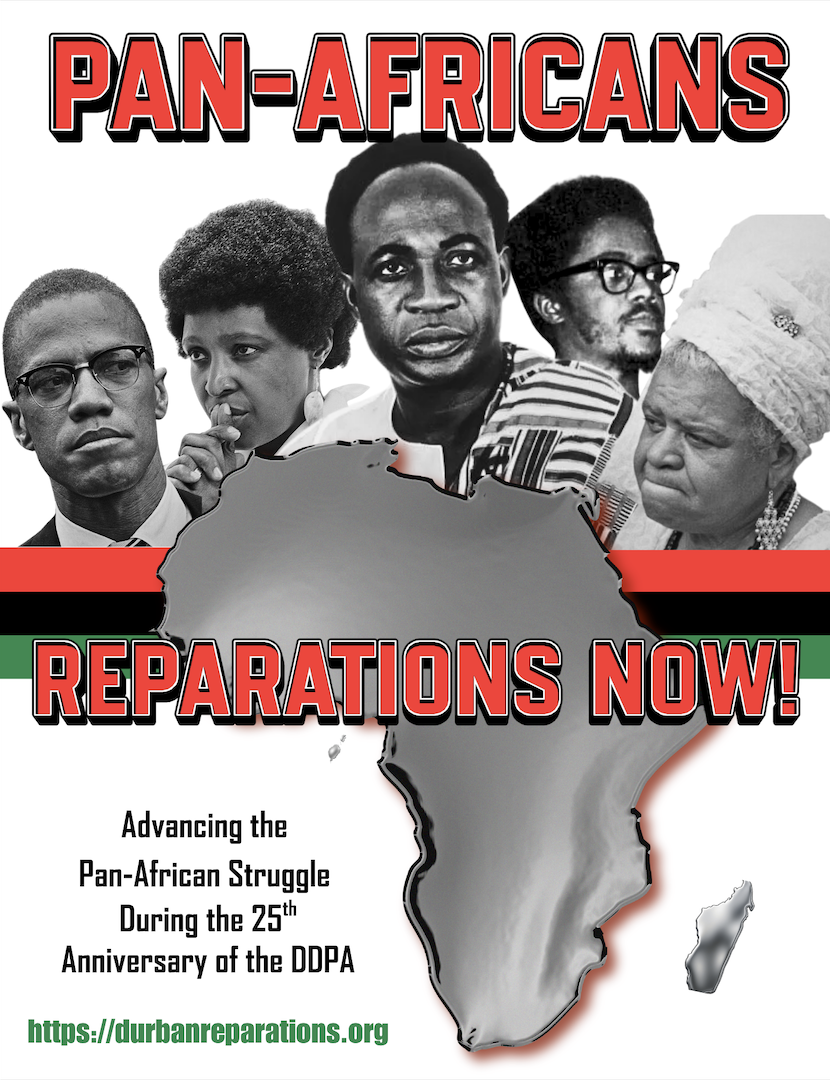
32 years ago, with the election of Nelson Mandela as President of South Africa, the Western world – former colonial and settler colonial states – tried to remove racism from the UN human rights agenda. They feared that with the formal abolition of apartheid, their racist practices would come under international scrutiny. In reply, the December 12th Movement, a UN-accredited NGO defending the human rights of Black people, renewed its year-long call for the UN to convene its third World Conference Against Racism. In 1997, when the UN finally agreed to hold the conference in 2001, the international fight for reparations and the demand for Pan-African unity began to escalate.
The December 12th Movement International Secretariat (D12) and the National Black United Front (NBUF) came together to organize around the U.S. to inform our communities and motivate maximum participation in the upcoming historic gathering. In parallel, we participated in the international (Geneva) and regional (Dakar, Chile, Vienna) Preparatory Committee meetings (PrepComs) which precede UN World Conferences. While there, we strived for unity around three issues: 1) a declaration that the Trans African Slave Trade, Slavery and Colonialism were crimes against humanity; 2) Reparations are due the descendants of the victims; 3) that the basis of racism is economic.
By the time of the second International PrepCom in May 2001, we had succeeded in forming a People of African Descent coalition which brought together Black people from the Caribbean, Central, South and North America, Europe, Australia and the Pacific Region who were committed to pushing their countries to support these 3 issues. These PrepComs resulted in Africans from the continent and throughout the Diaspora, reaffirming the clear parallels of our conditions, having all been subjected to Western imperialism.
D12 and NBUF organized 400 people (“The Durban 400”) to go to Durban. Without external funding, they paid for themselves and came as participants, not spectators. They, along with other members of the People of African Descent Coalition, lobbied, worked and collaborated with delegates and Ambassadors to produce the Durban Declaration and Program of Action (DDPA). The African Group and CARICOM members were the engine and leadership for the adoption of the Durban Declaration and Program of Action. The U.S. and Israel walked out of the conference rather than being forced to deal with reparations. Since adoption of the DDPA, the Western countries which agreed to it, have done everything in their power to disappear it.
Both historically and contemporaneously, the trafficking of enslaved Africans split the entire world into two forces – one representing humanity’s resistance to oppression and the other advancing that oppression and exploitation. The distinction between those who profited from these crimes and those whose peoples and lands were carved up to generate profit is clear. It is the mechanisms by which these criminals will be held accountable that we must elucidate, with a laser-like focus on humanizing the conditions of African people throughout the world.
The December 12th Movement has learned from the teachings of Malcolm X, that to overcome our conditions we must be in the fight for our human, not just civil, rights; that we must bring our local/national issues to the international arena. Our fight for Africans in New York City, since 1987, against police brutality, white vigilantism, and the violence of impoverishment, became translated to the work of the International Secretariat, organized to represent the 40 million Africans in the United States, presenting data on our conditions. (See the timeline on the back). Honing in on the strategy of 1) identifying the root of the systemic violence we face, 2) organizing to declare the economic root of that crime as without a statute of limitations, and 3) isolating reparations for the descendants as the necessary path forward to correct the course of humanity’s development.
The DDPA to the United Nations Declaration of Trafficking of Enslaved Africans (UNDOTEA) represents a relay-like hand off, one that is crucial to the integrity of the 21st century Pan-African human rights movement. We are permanently bridged to the 20th century’s national liberation struggles, breaking the European shackles on the blood vessels of African resources. And it is our disciplined study of OUR HISTORY, in the ongoing fight for our freedom that will steady our navigation, minimize detours, and mobilize the masses of our people towards steady victory.
“The Durban 400” and the People of African Descent Coalition were a relentless and continuous force, lobbying for our position in the midst of Western opposition to reparations. This is the role we must assume in the next stage of how to guarantee that there will be concrete implementation of March’s historic UN resolution. Recognizing the importance of the African-CARICOM alliance in this process, we want to ensure that there is equal participation of those Africans in the Diaspora who live outside of these entities. We compose the vast majority of diasporan Africans, residing in countries that are the perpetrators/beneficiaries of the gravest crimes against humanity. The history of Durban and our history in the Western hemisphere teach us that the success of UNDOTEA will be determined by the power of the mass movement we can mobilize to accomplish it. We remain ever mindful of the words of Frederick Douglass, “Power concedes nothing without a demand. It never has. It never will.”
In the U.S. we have launched the Campaign for August 29th, 2026: A Day for Pan-African Solidarity & Reparations, as a way to catalyze that mass support.
We are organizing supporters around the country and world to hold a rally, gathering, and/or meeting on August 29th, 2026 to celebrate the 25th anniversary of the Durban World Conference and UNDOTEA as a way to educate our communities and to get more people actively involved in this struggle.
We must now build in this moment on the reality that the world will change based on the determination of African people. Liberation struggles in the second half of the 20th century set the stage for our current reparations struggle. Reparations is a demand that asserts the fact that African people will determine our political and economic destiny against imperialism. This is a movement of the masses.