Durban 400
2001 United Nations World Conference Against Racism: DURBAN 400
D12 organized 400 delegates to ensure that three critical points were included in the Durban Declaration and Programme of Action (DDPA):
- Slavery was a crime against humanity.
- The roots of the transatlantic slave trade were economic.
- Reparations are owed to descendants of enslaved Africans.
D12 played a pivotal role in this significant Pan-African event, which established reparations as a global issue. The Durban conference marked a historic defeat for the United States and other Western nations, while providing a framework for the continued fight for reparations.
D12’s leadership in the reparations movement also includes:
- 1993 D12 makes the call in Geneva, Switzerland for a world conference against racism
- 1997 United Nation agrees to hold The World Conference Against Racism (WCAR) and D12, along with the National Black United Front (NBUF) begins organizing the Durban 400, which leads to the DDPA.
- 2002 D12 co-organizes the first national Reparations Rally in Washington DC and followup rallies in New York City (2003), Columbia, SC (2004) and Memphis, TN (2004)
- 2002-2007 D12 provided lead counsel for class action lawsuit against 17 corporations that directly profited from slavery.
- 2009 Presented at the follow-up to the WCAR in Geneva, Switzerland.
- 2013 D12 participated in the establishment of CARICOM’s reparations commission
- 2015-2024 Organized events under the United Nations International Decade for People of African Descent.
- 2020 D12 Demands that President Joe Biden issue an Executive Order for a 50 Billion Dollar Down Payment for reparations to bypass legislative roadblocks.
National Reparations Rally & Class Action Lawsuit
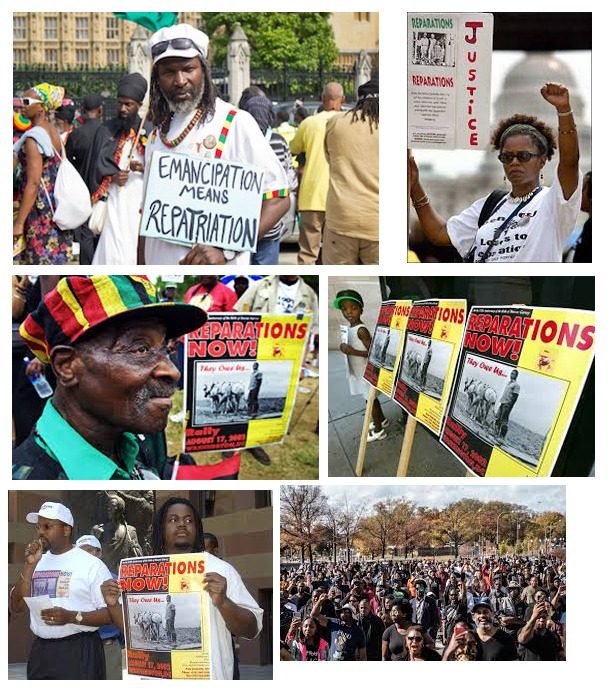
Following the Durban Conference, in 2002, D12 and the National Black United Front (NBUF) organized the first national reparations rally in Washington, D.C., bringing the demand for reparations to the forefront and highlighting the United States’ ongoing denial of its centuries-old debt.
In the same year, D12 provided legal counsel and organizational support for a class action lawsuit against 17 corporations—including Aetna, JP Morgan, and Fleet CSX—that directly profited from the trade, exploitation, and free labor of Africans in the United States. This legal action underscored the United States’ denial of its history and the slave trade as the foundation of its economic development, reinforcing our demand for reparations and addressing the collective economic conditions of Black communities.
CARICOM Reparations Commission
Despite the United States’ withdrawal from the 2009 Durban Review Conference, D12 continued to advocate for the Durban Declaration and Programme of Action. Demonstrating further Pan-African unity, D12 collaborated with The Caribbean Community (CARICOM), an intergovernmental organization, to help establish their Reparations Commission in 2013 and its 10-point plan.
Executive Order for Reparations
In 2020, after Joe Biden credited Black voters with securing his election victory, he pledged to support the Black community. D12 immediately tested this promise by calling for an executive order to allocate a $50 billion down payment for reparations. This strategy remains the most viable national approach, as legislative efforts have consistently failed to move beyond rhetoric. We stand firm on the need for an executive order that cannot be diluted by endless commissions or studies. An executive order for health care breaks the ice and begins a process of repair that establishes a collective approach that addresses the most vital needs of our community.